
Pay Plan Creation (Phase 2 of 3)
Trade contractors depend on compensation systems that reward performance, support predictable labor costs, and motivate field teams to meet production expectations. Pay Plan Creation is Phase 2 of the three-step Performance Pay Management process, and it builds directly on the findings from the Pay Plan Review.
This phase focuses on designing and implementing a structured, compliant performance pay system using verified data and real-world operational insights uncovered in Phase 1. While contractors are not required to complete all three phases, the Pay Plan Review must be completed before moving into Pay Plan Creation, ensuring the new system is built on accurate data and defensible assumptions.
Pay Plan Creation is a one-time project that can be used on its own or alongside an HR Mentor Retainer Account, depending on the level of ongoing support a contractor chooses.
See How Professional Pay Plan Creation Supports Contractor Performance
Many contractors rely on bonus structures or piece rates that were created years ago or expanded informally as the business grew. As teams scale and job complexity increases, these systems often become inconsistent, unclear, or misaligned with profitability and compliance goals.
Pay Plan Creation addresses these challenges by transforming the findings from Phase 1 into a clearly defined compensation structure that aligns with operational realities, supports predictable labor costs, and strengthens the connection between productivity and earnings. The result is a system designed to scale with the business rather than break under growth.
Understand the Process Behind Structured Compensation Plan Development
The Pay Plan Creation process begins with the data, risk findings, and recommendations identified during the Phase 1 Pay Plan Review. Production expectations, revenue models, labor costs, job cycle times, and historical performance trends are used as the foundation for plan design, ensuring the system reflects how work is actually performed in the field.
The design process draws on proprietary, trade-specific compensation plan models developed exclusively for production-driven contractors. These models serve as the framework for creating performance pay systems that balance efficiency incentives, labor budgeting, and wage-and-hour compliance—something generic incentive plans rarely achieve.
Based on the review findings, the appropriate compensation structure is defined, which may include:
Piece-rate calculations
Job-completion or performance bonuses
Revenue-per-labor-hour models
Tiered performance levels
Hybrid compensation systems
Each design choice is supported by documented rules, clear formulas, and practical standards that make expectations transparent and enforceable.
Strategic Design to Create a Clear and Compliant Pay Structure
Contractors often struggle with pay plans that unintentionally create wage-and-hour exposure or overtime liability. This phase focuses on strategic pay structure design that ensures compliance with applicable federal and state labor requirements while preserving performance-based incentives.
The design incorporates rules for training hours, apprentices or helpers, required rest breaks, sick time, and redo work. This allows non-commissioned team members to assist on jobs without reducing lead technician incentives, while still maintaining fairness, clarity, and compliance.
By addressing these rules at the design stage, contractors avoid disputes, inconsistent payouts, and supervisory guesswork while gaining confidence that the system is defensible and repeatable.
Receive Custom Tools Built for the Pay Plan System You Choose
Once your plan is designed, we build the tools that run it. You choose the level of complexity and how hands-on you want to be, and we build around your choice. We can hand off a custom calculator or sheet that does the math each pay period from the data you enter, start to finish in your hands.
We also offer two options for a system of ongoing pay plan management, either with our proprietary pay plans or a structure of your choice:
A full spreadsheet system. We pull in your job data and run calculations each pay period, including data rollups so you can track performance over time.
A custom web application. Our most advanced offering. Connected to your field service software, the system quickly assembles and checks each pay period for you and gives you detailed views of every data point.
Whichever you choose, we build it around your pay plan: hourly, salary, commissions, piece rate, bonuses, or any combination of them. We ensure calculations are compliant, including overtime and rest breaks based on your state’s regulations. Every pay plan comes with pay agreement templates, documented plan rules, and the materials to roll the plan out to your crews.
Run Your Pay Plan Through a Custom Web Application
We build custom web applications that connect to your field service system and pull your job data directly, so each pay period is assembled and checked for you with clear access to every data point. The app is programmed for whichever pay plan we design with you, whether that is one of our proprietary models or a structure of your own, and is built to be fully compliant for the regulations in whichever states you do business.
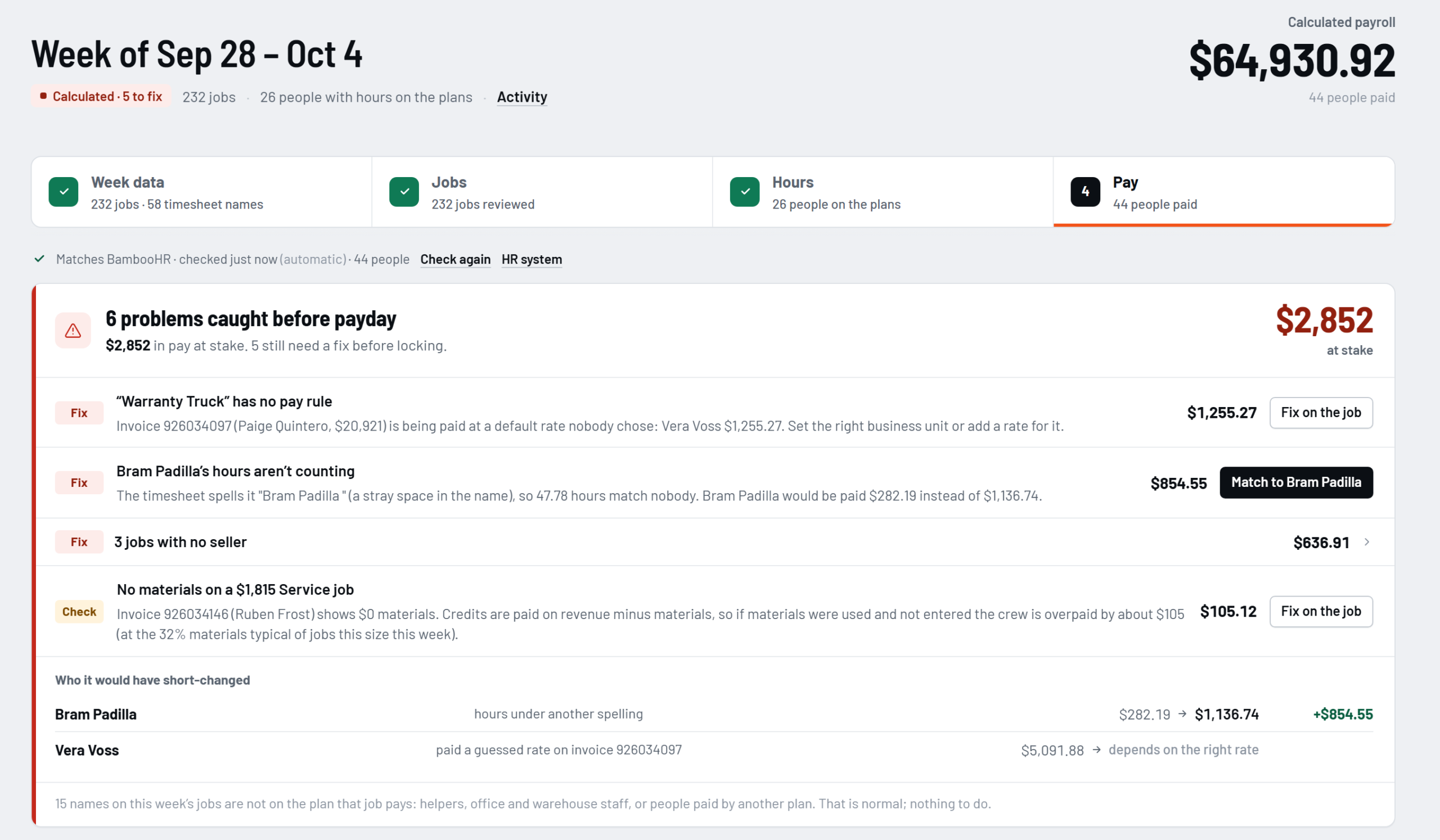
The benefits of using a custom-built web application linked to live job data include:
Complex pay calculations done accurately in just minutes
Mistakes caught before checks go out
Crews watch their pay building all week, so the office fields fewer questions
A simple breakdown of the math behind every paycheck
Custom reporting, including a high-level view of labor costs and crew performance, by pay period and over time
Recognize When Your Contracting Business Needs a New Pay Plan
You may need Pay Plan Creation if your Pay Plan Review identified compliance risk, data issues, misaligned incentives, or labor costs that are difficult to control. This phase is the next step for contractors who want help fixing what the review uncovered and implementing a structured, compliant system.
Contractors typically begin with the Pay Plan Review (Phase 1), move into Pay Plan Creation (Phase 2) to build the corrected system, and then consider Ongoing Performance Pay Management (Phase 3) for continued administration and oversight.
Built on Review—Designed for Long-Term Performance
Pay Plan Creation turns analysis into action, using verified data and operational insight to build a compensation system that works in the real world.
Phase 1 – Pay Plan Review
Start With a Verified Pay Plan Assessment
Every performance pay system begins with a detailed review of compliance, data accuracy, and profitability. The Pay Plan Review identifies risks and inconsistencies that must be addressed before a new system can be built.
Phase 3 – Ongoing Performance Pay Management
Ensure Accuracy With Ongoing Oversight
Once a new pay plan is designed, many contractors choose ongoing management to eliminate calculation risk and administrative burden. This phase provides professional processing, reporting, and compliance oversight each pay period.